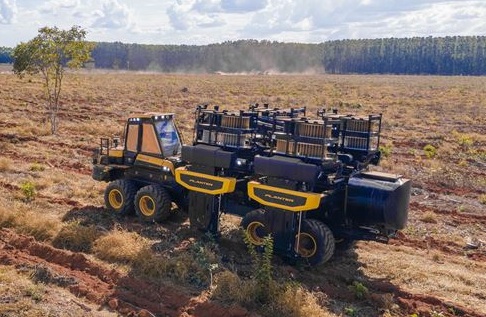
This is the first tree-planting innovation in the company’s history.
The Ponsse Buffalo Planter is a tillage and planting unit mounted on the frame of a forest machine, enabling mechanised and automated planting. The Buffalo Planter is Ponsse’s solution for mechanised forest regeneration, with the entire planting process carried out by a single machine. Built on the Ponsse Buffalo forwarder platform, the planting machine performs spot tillage, plants the seedlings and waters them – all in one seamless process.
Developing the Buffalo Planter marks a new step for Ponsse, moving from harvesting technology into forest regeneration solutions and broader life-cycle support. In the first phase, the primary market for the planting machine is South America, where its benefits are most evident on plantation sites. The Buffalo Planter improves the productivity and cost-efficiency of forest regeneration by enabling large areas to be planted in a shorter time. The automated planting process ensures a high-quality and consistent planting result, creating good conditions for seedling growth and reducing the need for later replanting. Outside the planting season, the system can be converted back into a conventional forwarder, which improves the machine’s utilisation rate.
In addition to speeding up the work, the Buffalo Planter brings safety and ergonomic benefits to the planting process. Digital systems support the monitoring, reporting and documentation of work. To ensure the high quality of the work, the cameras installed on the planting device transmit information about ground-level events to the operator in the cabin. Thanks to automation, only one person is needed to control the Buffalo Planter and carry out the planting work: the operator of the machine.
The planting system consists of four planters, two on each side of the machine. Each unit has a separate tillage head, as well as a planting head that takes care of planting, watering and compacting the seedlings. The planting interval of the trees is adjustable both laterally and in the direction of travel. The seedlings are fed through four seedling cassettes with a total capacity of up to 960 seedlings per load. With spot mounding, the working rate is around 750 seedlings per hour, while without tillage, the machine can plant around 1,300 seedlings per hour.
The innovative Buffalo Planter was developed in collaboration with Ponsse’s technology company Epec and Novelquip Forestry, a South African company specialising in planting equipment. Source
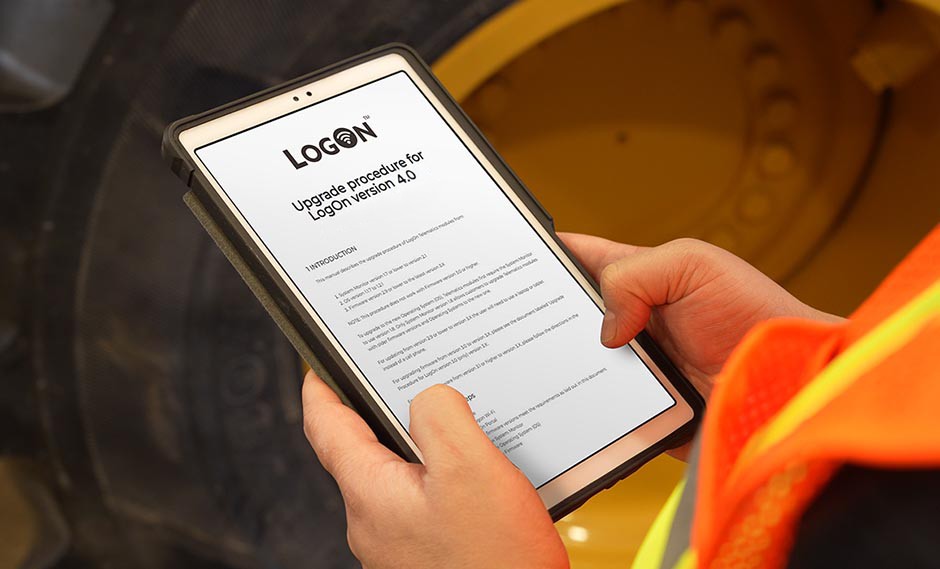
The latest telematics firmware provides added functionality, an improved user interface, and takes advantage of the latest advanced engine diagnostics capabilities.
The firmware V4.0 update offers enhanced features for a more comprehensive telematics experience including an updated LogOn web interface, with the inclinometer on the main screen and a dedicated text messaging icon. With the latest update, LogOn puts more diagnostic and repair resource in your hands. Users with RemoteLog equipped machines now have the ability to perform an inducement unlock without the need for an unlock PIN.
Tigercat Industries has developed more advanced and comprehensive tools for troubleshooting. The LogOn interface provides easy-to-understand steps to diagnose issues, directly referencing the appropriate section of the service manual. Several diagnostic tests can be initiated directly from LogOn to further diagnose the underlying reason for the fault code.
J1939 Diagnostics records CAN bus traffic from any CAN devices, sensors or actuators on the machine. After the CAN messages are recorded, they can be downloaded to the user's device to aid in diagnosing integration issues with equipment on the machine. CAN Analyzer can now capture CAN data based on a trigger that can be set to either an ArbID or a PGN. The capture will stop after the specified time post trigger when the trigger is detected, or on the Stop button. A bulk recorder has been added that records all CAN traffic until clicking Stop or when the recording file size reaches a maximum size.
A complete Engine ECU Stores Data report is now generated when requesting stored data from the ECU. Engine and aftertreatment diagnostic tests now include:
- The Compression Test detects relative low cylinder compression by controlling fuel and measuring crankshaft speed during engine cranking
- The Runup Test checks the fuel injection system for proper operation and performance
- The High Pressure Rail Test checks the fuel rail system for proper operation and performance, including fuel rail pump performance, system leakage, fuel pressure regulator tightness variation, and fuel pressure control instability
- The Exhaust Flap Valve Test runs a sequence of position requests to the exhaust flap actuator and compares the requested positions to the actual positions
- Several aftertreatment tests including the Urea Dosing System Test (UDST), Urea Dosing Pump Check (UDPC), and Urea Dosing Leakage Check (UDLC)
Colour coding has been added to the Engine Diagnostics reporting screen to make it easier to comprehend the status of the test. This applies to all the tests available in Engine Diagnostics. Source
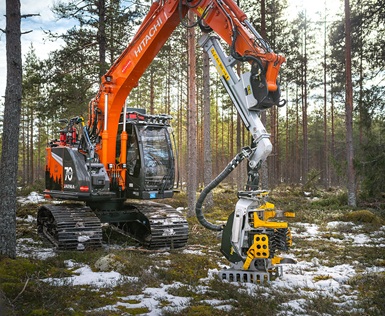
This is the result of a growing need to enhance the performance of lightweight thinning harvesters and excavator-based harvesters without increasing engine power.
Kesla’s new powerB pressure accumulator system provides an effective response to this challenge by delivering significant additional power during critical work phases. The solution improves harvester performance, productivity, and fuel efficiency without the need to increase engine power.
Light thinning harvesters and excavator-based harvesters often face challenges such as low feed speed and limited sawing power, which reduce work efficiency and make handling difficult trees more demanding. Kesla powerB addresses these challenges by efficiently utilizing load fluctuations in the hydraulic system.
In harvester operations, the power demand of the hydraulic system varies continuously, and rapid changes also cause pressure spikes that are detrimental to the system. The PowerB pressure accumulator system is connected to the harvester’s pressure line, where it stores energy. At the same time, the system smooths pressure variations and filters pressure spikes, improving the durability and reliability of the hydraulic system and hoses. The stored energy is utilized at moments when the harvesting head’s energy demand is at its highest, such as during sawing and feeding.
The core of the PowerB system is its valve and control logic, which manages energy charging and utilizing cycles with millisecond-level precision at exactly the right moments. The control system also ensures operational safety by discharging the accumulator energy in a controlled manner when the harvesting head is not active, ensuring safe machine operation and maintenance.
Kesla powerB integrates seamlessly into the extensive Kesla xTimber product family for excavator harvesters. The system is also ideally suited for lightweight thinning harvesters with limited engine power. The Kesla powerB system is available for all Kesla harvester heads controlled by Kesla proLOG, xLogger, or Dasa control systems. Source

Diesel powertrains and battery electric powertrains each offer distinct advantages depending on the application.
Cummins explains that diesel excels in long-distance travel, durability and versatility across industries like trucking, agriculture and mining, while electric powertrains are best suited for urban stop-and-go driving and offer zero tailpipe emissions with lower maintenance requirements.
Today's clean diesel engines emit 90% less emissions than engines produced before 2000, and Cummins on-highway engines from 2007 onward are compatible with up to B20 biodiesel, offering a lower-emissions option for those not yet ready to switch to electric.
As technology and infrastructure continue to evolve, both powertrains play a role in the broader sustainability objectives for the transportation industry. Discover the differences between diesel powertrains and battery electric powertrains, and how both help us in our journey to reduce emissions. The powertrain refers to a set of parts that work together to provide the power to move a vehicle.
Diesel powertrains use a diesel engine to power the vehicle. Diesel fuel is injected into the engine, which creates thermal energy through combustion and generates the power to move the vehicle. A diesel powertrain includes the transmission, drive shafts, differentials and axles that work together to move the vehicle.
In electric vehicles, the components of a powertrain are a bit different, but the basic idea is the same. Instead of an engine, there is an electric motor. Instead of a fuel tank, there is a battery. The motor uses energy from the battery to spin the wheels. The powertrain includes power electronics, like an inverter, to control the speed and the power of the electric motor and a vehicle controller to align all the main and auxiliary power components based on energy needs and consumption. Depending on a customer’s application and needs, the powertrain can include either a single or multi-speed transmission.
Like how a diesel vehicle goes to a diesel station when it’s time to refuel, an electric vehicle would go to a charging station. There are different levels of charging stations available to meet the demands of electric commercial vehicles. The adoption of higher-power charging stations in the future will reduce the charge time to be similar to how long it takes to refill a diesel tank.
When we compare diesel engines and battery electric powertrains, they have their strengths and challenges. Electric vehicles lead the way in sustainability as they don’t emit carbon emissions when in operation. On the other hand, while diesel engines still emit emissions, diesel technology has improved. Today’s clean diesel engines emit 90% less emissions than the engines produced before the year 2000. Additionally, all Cummins’ automotive and industrial engines are compatible with B5 biodiesel. Cummins’ on-highway engine models from 2007 on (to today) are B20 compatible.
Each powertrain type offers key advantages and benefits to customers. Electric powertrains are best suited for urban city transportation where drivers experience stop-and-go traffic more frequently. Each time an electric vehicle stops, energy is generated by the electric motor and fed back into the onboard energy storage system to be used for the next acceleration. Electric powertrains require limited maintenance as they do not have as many parts – no fuel filters, aftertreatment systems or additives.
There are also key advantages to diesel engines. Diesel engines are some of the most fuel and energy-efficient options in the market. They are a great option for long-distance travel, as diesel vehicles can travel 20% to 25% farther on a single gallon of fuel compared to similarly sized gasoline vehicles. In addition to their long-distance capabilities, diesel engines have a long lifespan, built tough to handle high compression and hard work. They deliver strong acceleration, towing and hauling potential.
The trucking industry is increasingly adopting electric powertrain systems for medium and heavy-duty applications. Battery electric trucks significantly reduce operating costs due to lower fuel and maintenance expenses, and with zero tailpipe emissions, they contribute to cleaner air quality and the reduction of greenhouse gas emissions. Source
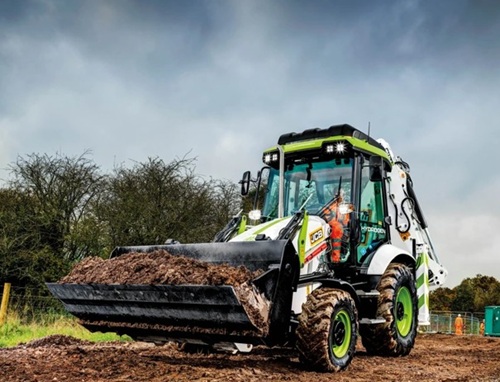
JCB has been working on hydrogen engine technology for over five years
JCB has been working on hydrogen engine technology for over five years, investing more than £100 million in the development of the JCB Hydrogen engine and JCB Hydrogen equipment. The company has extensively trialled the technology with customers in working site conditions, across power generation, Loadall telescopic handlers and in the 3CX Backhoe Loader.
Customers working with the machines reported identical power and torque characteristics to their traditional diesel machines, with no requirement for operators to change their way of working or adapt to the new technology. JCB has developed a mobile refueller in cooperation with HYKIT that enables easy, rapid filling on site when required, with none of the lengthy charging times associated with battery electric machinery.
The 3CX Hydrogen is powered by a 55 kW (75 hp) version of JCB’s hydrogen engine. The machine has three composite-wrapped hydrogen tanks, mounted on the cab roof, providing enough storge at 350 bar pressure for all-day operation. Other than the hydrogen storage tanks and fuel distribution lines, the machine will feel familiar to backhoe loader customers across the world. The hydrogen engine delivers the same power and torque as the diesel model and requires similar service and maintenance intervals, making it easy to adopt.
Hydrogen combustion engines also offer other significant benefits. By leveraging diesel engine technology and components, they do not require rare earth elements and critically, combustion technology is already well proven on construction and agricultural equipment. It is a technology which is cost effective, robust, reliable and well known throughout not just the construction and agricultural industry, but the whole world.
JCB is the world’s first construction equipment manufacturer to develop a fully approved combustion engine fuelled by hydrogen and the first to deliver that technology in a production backhoe loader. The company has built more than 150 hydrogen engines during the evaluation process, demonstrating the technology to His Majesty King Charles III during the monarch’s visit to JCB’s recent 80th birthday celebrations. Source
JCB targets new land speed record using its own hydrogen engines
British engineering giant JCB is targeting a new land speed record with a 32-foot car powered by its own hydrogen engines. 20 years after rewriting the record books with the JCB Dieselmax car, the company is returning to the Bonneville Salt Flats in Utah to attempt a new speed record – this time using hydrogen power. JCB Hydromax will run with two production-based hydrogen engines, producing a combined 1,600 bhp. Source
Kesla Strengthens Staffing at the Kesälahti Plant
Kesla Oyj, a Finnish developer and manufacturer of forest machines, technologies and services, is recruiting around 10 new permanent employees for its Kesälahti plant already before summer 2026, driven by increased production volumes and a strengthened order book. As part of this development, Kesla has also decided to end the furloughs implemented at the Kesälahti plant during 2025 and early 2026, and production will continue at full capacity. Source
Read More“Optimizing deployment of mobile biochar production equipment for enhanced slash management”
International Journal of Forest Engineering, 2026. Kim, G., Chung, W., Anderson, N. M., & Woo, H. Source
“Responding to hurricane disruptions: salvage decisions under uncertain timber supply”
International Journal of Forest Engineering, 2026. Pereira Sartorio, I., Kanieski da Silva, B., Tanger, S. M., et al. Source
Read MoreTo see the full list of international logging, roading and trucking conferences and expo’s, please click the “Events” tab at the top of the page.
Read More